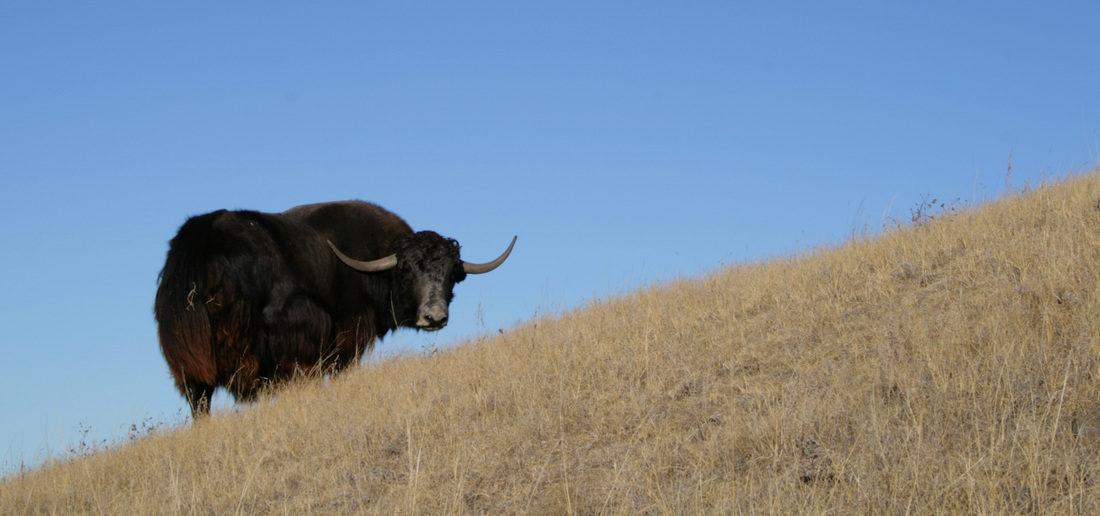
 So here I am at the kitchen table trying to get a better handle on the inner workings of the Canadian establishment with a copy Drisdelle's, "Parasites: Tales of Humanity's Most Unwelcome Guests," when around the bend of our drive comes our neighbor Harold in his pickup. Harold needs help with a task he can't handle on his own, and so off we go. We don't engage the term "bovine" too often as a compliment, remember, and here we have a Hereford lain on her side with her feet on a vaguely uphill grade, and due to the insurmountability of her balloonish midsection, is now powerless to get up. She'd been there for some time, it would seem, as evidenced by the brown pond adjacent her hoop, in which she had thoroughly plied her tail. (However this turns out, stay back from the tail, I remind myself.) "Oh Lord," was one preliminary thought, "She's having trouble birthing and one of us sure as hell will soon be up to our shoulder in her wildebeest trying to turn the calf!" Her tail a paint-brush. Immediately followed by, "Why do all cows seem to live in a perpetual state of diarrhea?" and then the revelation, "It's not enough to make responsible decisions in choosing for yourself only those proper animals that can birth naturally when your neighbor insists on keeping up the tradition of raising only those animals we've thoroughly screwed..." when, praise-be, it became evident that while pregnant, this was not the true nature of her predicament. She was simply defeated by her own preposterous design. Lucky it was us and not coyotes coming to her aid. I am sure, in fact, that if we hadn't been there to lend a hand, this would have been a scene to be immortalized on canvas as "Bessie's Final Gesture." Serving perhaps as a symbol for where the process of domestication was taking us all - a bloated carcass to be eaten alive by scavengers. As it turns out, the fix is embarrassingly simple. Harold applies a lariat to both her hind feet. We heave until she's rotated 90 degrees, (thankfully the ground is slippery with snow and less pristine substances,) head now upslope, such as the slope was. She gets up and walks off, as if she's only been napping a moment or two. Domestic cattle were established in western North America mostly by English elites of the then prevailing Empire in order to better provide for an insatiable appetite amongst the British aristocracy for beef. Big money cleared all hurdles, and with this backing, the cattlemen of the west carried mighty political clout, the remnants of which, despite the cattle industry being in severe present peril, remain to this day. Observe single-family holdings of vast estates here in the west, acquired and held on to for a veritable pittance by the standards of today due to this history of partisan politics. And so worked, and works - barely - the mechanism by which an animal far from optimal for its situation became every bit as sacred to westerners as it is to the Hindu, nevermind that we eat it. Anyways, to hell with cows, and pity the poor cowboy tending these squalid hordes. Here's a better solution: 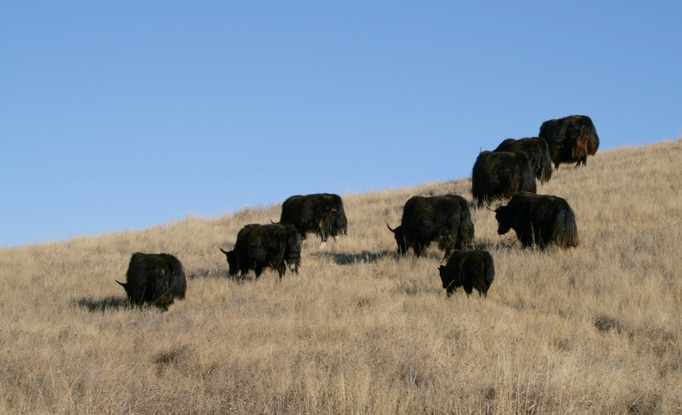 The yak was introduced to North America by way of Canada, and we can thank naturalist and artist Ernest Thompson Seton for this. Seton presented the idea that yak would be the perfect animal for the Canadian plains to Lord Albert Earl Grey, the Governor Central of Canada. Lord Grey presented Seton’s idea in a letter to Lord Elgin, the Secretary of State for the British Colonies. In his letter Grey states that the Premier of Canada, Sir Wilfrid Laurier, had already requested a formal report from Seton. The project was given the thumbs-up and the original animals were acquired from Herbrand Russell who was the 11th Duke of Bedford, President of Zoological Society, savior of Pere David’s Deer and who had a herd of his own yaks at Woburn Abbey. In 1909 a small group of the animals arrived in Brandon, Manitoba for research purposes. The answer to the question is this the ideal domestic animal for the Canadian plains is of course, "No," the bison was and is the ideal animal for the Canadian plains, but you know the story there. The yak is certainly second-best, and when you factor in ease of handling, they have bison beat. The yaks failed to thrive in Brandon, low elevation being blamed. They were moved to Banff, did much better there, and by 1919 a sizeable herd was the result. Animals were then moved to Wainwright, Alberta where the original question somehow became twisted out of shape thanks one can imagine to political meddling by the already deeply-entrenched cattle industry. The question became, "Can the yak be used to improve cattle, can cattle be used to improve yak?" The answer of course was again, "No," you breed them together and you get a critter that performs poorly as both a cow and as a yak. So the project was abandoned as we turned back to our cows. On the plus side, there were now yaks in Canada, in North America. Now, on to the details. Who better than the International Yak Association (IYAK) to further illuminate the superior qualities of this "Cow that should have been"? "The strength and value of the yak comes from its amazing versatility. Try to find an animal that can fill so many roles. Their fiber or wool compares to the finest fibers in the world and is enjoying growing international interest as companies like Khunu and Shokayintroduce the work of the indigenous peoples of the Himalayas to amazing yak fiber products. Even Newsweek is jumping on the yak wagon! Yak leather is THE Premium Leather for Ecco's top lines not because it is different but because it allows them to produce a superior shoe. According to Ecco's testing, yak leather is up to three times stronger than traditional leathers allowing them to produce lighter and longer wearing shoes. The health benefits of yak cheese are becoming famous world wide. Yak meat is becoming a favorite restauranteurs, chefs, health conscious foodies, and folks looking for a delicious alternative to everyday beef. As a companion animal, you will not find a more intelligent and hard working partner. "Yak down is the softest yak fiber and is the undercoat the animals grow for insulation in the colder months. It is shed in the spring and is wonderful stuff for woven and knitted garments. The down is a short fiber--about 1-1/2" long with some crimp, and it may be challenging to spin unless it has been carded into a roving. As you can see below, the fineness of the yak down fiber could be equated to merino wool or cashmere, and close to qiviut (musk ox down). Yak down does not have the lanolin that makes sheep wool greasy, so you don't lose much in weight when it is washed. The other fibers are medium length (about 2-3 inches) guard hair that is usually mixed in with the down when it is combed out, and then the long, really coarse guard hair that creates the yak’s “skirt”. A rug woven from this guard hair would wear extremely well. "The amount of down fiber on the yak’s back may vary between animals, but it has been shown that the cooler the climate and longer the colder weather lasts, the more dense a coat of down fiber the animal grows. The density of the down coat is greater in calves than adults because their bodies have not built up the fat and hide thickness to protect them from a harsh, cold environment. The denseness of the down coat usually decreases with age as the animal builds up more subcutaneous fat and its hide becomes thicker. "Yak meat's sweet, juicy, delicious flavor is never gamey and is not dry unless overcooked. Although very lean, the juiciness and flavor of yak meat comes from its unique mixture of fats that are low in saturated fats, cholesterol and triglycerides. Yak is a red meat that offers heart patients a new opportunity for fine dining and offers athletes a diet exceptionally rich in body building proteins, minerals, vitamins and the right fats for building muscle mass and good health. This healthy and delicious meat product is a driving force behind the yak’s value and success as a profitable livestock enterprise. "Yak Milk, contrary to legend, is not pink but yak butter's legendary status is well deserved. Yak butter tea is the comfort food of the Himalayas. Yak milk is rich in butterfat at around 6% to 11% and this makes it perfect for yogurt, butter, and cheese. No animal has such a history of carrying heavy loads in extreme terrain. Their sure-footedness makes them the only choice for the world's most famous mountain climbers and folks just looking for a some time away." 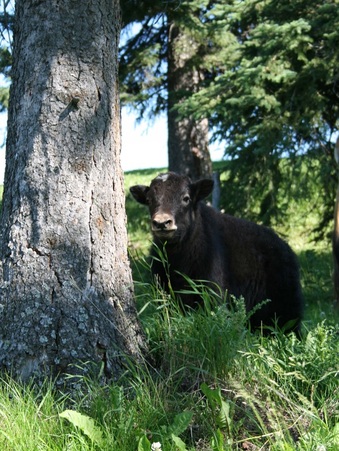 Baby Rose, a calf from this year. Baby Rose, a calf from this year. We would add a few anecdotes here. People interested in sheep but worried about the predator problem (amongst other problems with keeping sheep,) might consider the yak instead: woe to any coyote who would make lunch of a sheep who tries to do the same to a yak - they have little tolerance for such nonsense and he'll just as likely end up skewered! Coming from dry areas, yaks utilize moisture better than cows. Their droppings are not a perpetual filthy mess like a cow's, but rather more like an elk's. Also, they don't swarm around waterholes, streams, or rivers all summer as cows do, destroying the ground, the riparian habitat, and fouling the water. They eat about 1/2 as much as a cow pound-for-pound, allowing higher stocking rates, if that's your goal. They also eat a broader range of vegetation. On our old place they virtually eliminated kochia, a noxious weed nothing else would touch, and put a dent in the snowberry invading the native grasses. They are calmer than cows, easier to handle, and as our friend Ken at Rafter K 2 Farms, a man who has raised both cattle and yaks reports, this is likely due to the fact that there is no comparison in intelligence between a yak and a cow, nor in health issues. They tend to birth easily, naturally, without assistance. We appreciate also that yaks are not prone to rending the otherwise peaceful country air with penetrating, moronic noises ala the cow. A relatively soft and infrequently uttered grunt is their only call. Finally, yaks are picturesque. They seem to fit the wild landscape, to look appropriate there, where cows always seem to detract from any scene beyond the dairy fold. They are much like bison this way. In fact, we have often reflected that a yak can be viewed as a small bison that will make friends with you rather than try to kill you. We are very happy to have a growing herd of yaks again on our place. Aside from their many uses, they lend us a sense of well-being by their very presence. And hey, maybe things are coming full circle: yaks now have at least token backing from the new generation of British aristocracy. When the young Royals were here recently, guess what they dined on? 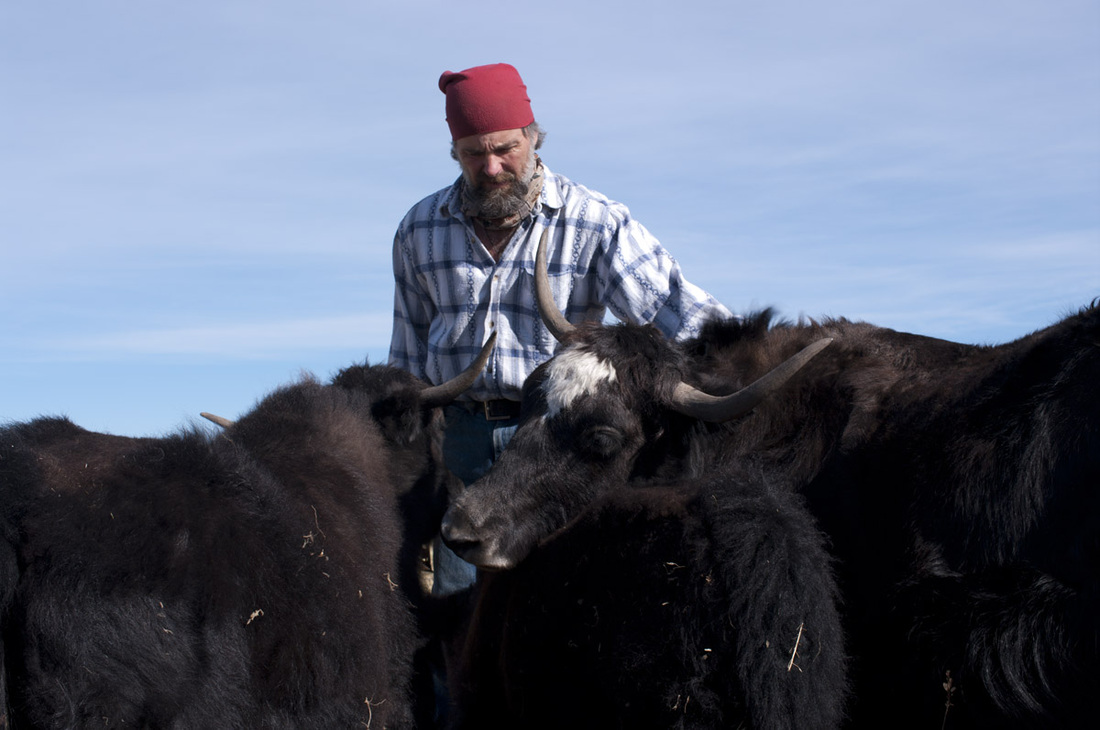 Yaks, beautiful and ancient cattle, very much enjoy and vie for attention. Photo: Laura Fetherstonhaugh
3 Comments
|
AuthorHave a look at our "Education/Contact" page for info on the author. Archives
March 2020
Categories
All
|
 RSS Feed
